





OEM vs. ODM Umbrella Manufacturing: What's the Difference?
 Nov 19, 2026|

Choosing between OEM and ODM umbrella manufacturing depends on how much control you need over product design, customization, and production. Understanding the differences can help you select the right manufacturing model, manage costs, and find a suitable supplier for your business.
1. What Is OEM Umbrella Manufacturing?
OEM (Original Equipment Manufacturer) means the buyer provides the product design, technical drawings, or reference samples, while the manufacturer produces umbrellas according to the specifications.
OEM is suitable for businesses that already have a clear product concept and want greater control over the final product.
Common OEM customization options include:
- Canopy fabric, colors, and printed patterns.
- Umbrella size and folding structure.
- Shaft and rib materials, such as iron, fiberglass, aluminum, and carbon fiber.
- Handle styles and accessories.
- Logo printing and packaging design.
For example, a brand may provide a design for a three-fold automatic umbrella with a specific canopy pattern, fiberglass ribs, and a customized handle. The manufacturer develops samples and produces the umbrellas according to the approved specifications.
2. What Is ODM Umbrella Manufacturing?
ODM (Original Design Manufacturer) means the manufacturer provides existing product designs or helps develop a product based on the buyer's requirements.
Instead of creating a complete design from scratch, buyers can select an existing umbrella model and customize details such as colors, logos, handles, and packaging.
ODM manufacturers may also provide design drawings, logo mockups, packaging suggestions, and sample development based on reference images or physical samples.
This model is suitable for wholesalers, retailers, and promotional product companies that want branded umbrellas without managing the entire design process.
3. What Is the Difference Between OEM and ODM?
The main difference is who takes the lead in product design and development.
| Comparison | OEM | ODM |
|---|---|---|
| Product design | Usually provided by buyer | Provided or developed by manufacturer |
| Development | Buyer-led | Manufacturer-supported |
| Customization | Greater design flexibility | Usually based on existing models |
| Development workload | Higher for buyer | Lower for buyer |
| Suitable for | Established brands | Retailers and wholesalers |
OEM is generally better for businesses with unique product requirements. ODM is often more practical for buyers who want to customize existing designs and reduce development work.
Neither model is automatically cheaper. The final cost depends on materials, customization, sampling, packaging, and order quantity.


4. What Customization Options Are Available for Umbrellas?
Custom umbrellas can be adapted through different materials, structures, and accessories.
Canopy Fabrics
Common options include pongee, black-coated pongee, and silver-coated pongee. Fabric specifications may include 190T, 210T, 230T, 260T, and 280T. Other specifications, such as 30D, 50D, and 75D, may also be available depending on the fabric.
Frame and Structure
Shaft and rib materials may include iron, fiberglass, aluminum, and carbon fiber. Available structures include straight umbrellas and two-fold, three-fold, and five-fold umbrellas.
Depending on the model, buyers may also choose different rib configurations, such as 6, 8, 10, 12, 16, or 24 ribs.
Handles and Branding
Customization may include wooden handles with laser-engraved logos, fastening straps, metal buttons, umbrella sleeves, tips, and end caps.
Packaging options include OPP bags, fabric bags, color boxes, capsule boxes, and gift boxes.
5. How Do Manufacturers Control Umbrella Quality?
Quality control should cover materials, assembly, functionality, appearance, and packaging.
Important inspection procedures include:
- Material inspection: Checking canopy fabric, frame components, handles, and accessories.
- Opening and closing tests: Checking smooth operation and mechanical performance.
- Rainproof testing: Evaluating water resistance under specified rainfall conditions.
- Appearance inspection: Checking stitching, printing, colors, and product defects.
- Pre-shipment inspection: Comparing finished products with approved samples.
For example, one documented testing procedure uses 600 opening and closing cycles for manual straight umbrellas and 400 cycles for folding and automatic umbrellas.
A rainproof test may reference GB/T 23147-2018, using rainfall intensity of 4.4 ± 0.2 mm/min for two minutes.
Buyers should confirm the actual testing standards, acceptance criteria, and AQL inspection levels before production. Third-party inspection can also be arranged when required.
6. What Are the MOQ and Lead Times for Custom Umbrellas?
MOQ and production schedules depend on product design, materials, and customization requirements.
Typical reference figures include:
| Item | Reference |
|---|---|
| Customized umbrella MOQ | Around 100 pieces |
| Stock product sample | 1–2 days |
| Customized sample | 5–7 days |
| Bulk production | 15–25 days |
| Payment arrangement | 30% deposit, 70% balance before shipment |
Some stock products may be available without a minimum order quantity. However, customized fabrics, special handles, printing, and packaging may affect the MOQ.
These timelines are estimates and should be confirmed with the manufacturer before placing an order.
7. How Do You Choose a Reliable OEM or ODM Umbrella Manufacturer?
Before choosing a supplier, consider these factors:
1.Production capacity: Check factory size, production lines, workforce, equipment, and annual output.
2.Product experience: Review available umbrella structures, materials, and customization capabilities.
3.Design support: Confirm whether the manufacturer can work from drawings, samples, and digital design files.
4.Quality control: Ask about functional tests, rainproof tests, AQL inspection, and third-party inspections.
5.Sampling and lead time: Confirm sample costs, development time, and bulk production schedules.
6.Export experience: Check packaging options, shipping methods, and available trade terms.
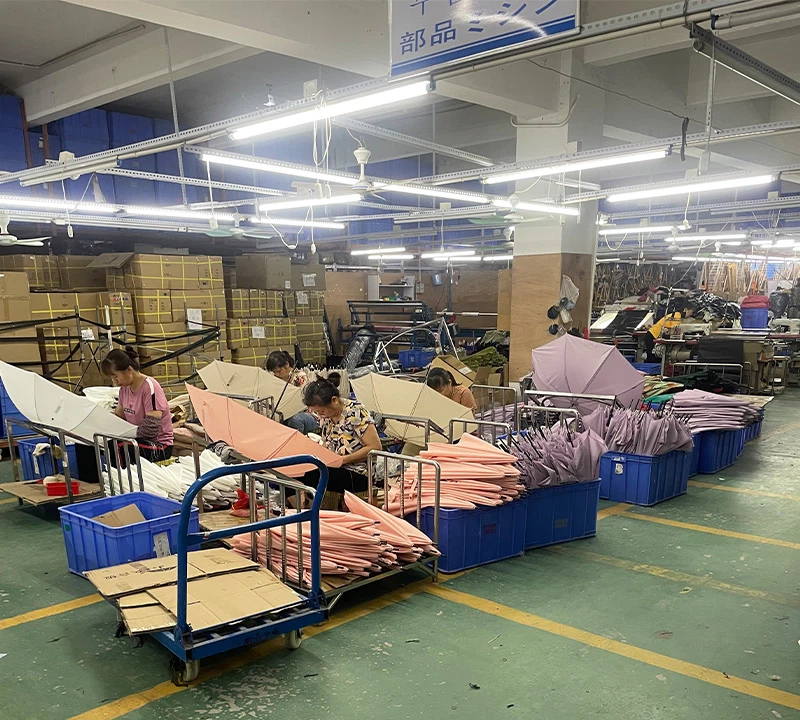
For reference, an umbrella production facility with 5,000 square meters of factory space, 100 employees, four production lines, and an annual capacity of 500,000 umbrellas illustrates the type of manufacturing information buyers can request when evaluating suppliers. Actual available capacity should always be confirmed.
FAQ
Q: Is OEM or ODM better for custom umbrellas?
A: OEM is suitable for buyers with their own product designs. ODM is better for businesses that want to customize existing umbrella models.
Q: Can I add my logo to an ODM umbrella?
A: Yes. Logo printing, canopy colors, umbrella sleeves, and packaging can commonly be customized.
Q: How long does it take to develop a custom umbrella sample?
A: A reference timeline is 1–2 days for stock samples and 5–7 days for customized samples.
Q: What is the MOQ for custom umbrellas?
A: A reference MOQ is around 100 pieces, although some stock products may have no minimum order quantity.
Q: Can manufacturers ship umbrellas internationally?
A: Many manufacturers support international shipping through courier services and sea freight, including full-container and less-than-container-load shipments.
Conclusion
OEM and ODM umbrella manufacturing serve different sourcing needs. OEM offers greater control over product design, while ODM helps buyers customize existing products with less development work. Before choosing a model, compare customization options, sample quality, testing procedures, MOQ, production lead time, and export arrangements to make a well-informed purchasing decision.