





Why Carbon Fiber Umbrella Are Expensive: Cost Breakdown
 Aug 13, 2026|
A carbon fiber umbrella usually costs more than a conventional steel or aluminum umbrella, but the higher price is not simply because "carbon fiber is expensive." The cost comes from a combination of advanced materials, specialized processing, precision frame construction, quality control, and product positioning. For buyers, understanding these cost factors makes it easier to determine whether a premium carbon fiber umbrella is genuinely worth the price.

Why Does a Carbon Fiber Umbrella Cost More?
The main cost difference can be summarized as follows:
| Cost Factor | Impact on Umbrella Price |
|---|---|
| Carbon fiber material | High |
| Composite processing | High |
| Precision frame construction | Medium–High |
| Joints and components | Medium |
| Quality control and testing | Medium |
| Customization | Medium |
| Packaging | Low–Medium |
Carbon fiber is attractive because it combines low weight with high mechanical performance, but manufacturing it requires more controlled processes than conventional metal components. NREL reports that industrial-grade carbon fiber manufacturing costs can vary significantly depending on fiber type and quality.
Carbon Fiber Material Is a Major Cost Driver
Why Is Carbon Fiber More Expensive Than Steel?
Steel benefits from decades of high-volume manufacturing and relatively mature forming processes. Carbon fiber, by contrast, involves multiple production stages, including precursor processing, oxidation, carbonization, surface treatment, sizing, winding, and inspection.
A U.S. Department of Energy technical cost model illustrates how these different manufacturing stages contribute to the cost of carbon fiber production.
For an umbrella manufacturer, the cost does not stop at purchasing carbon fiber. The material must then be formed and integrated into ribs, shafts, and other structural components with consistent dimensions.
Buyer Insight: When comparing suppliers, ask what parts of the umbrella actually use carbon fiber rather than assuming the entire frame is carbon fiber.
Specialized Processing Adds to the Cost
Carbon fiber is a composite material, so manufacturing quality can have a major influence on the finished product. Fiber orientation, resin systems, curing, dimensions, and surface quality all need to be controlled.
This is particularly important for umbrella ribs. A rib that is too flexible may provide poor support, while excessive stiffness can make the structure less tolerant of sudden loads.
Therefore, a premium carbon fiber umbrella is paying for material + processing + engineering, rather than material alone.
Precision Frame Construction Matters
The frame is another important part of the cost.
A high-quality carbon fiber umbrella may require carefully designed:
Carbon fiber ribs
Carbon fiber shaft
Reinforced joints
Metal connectors
Springs and runners
Canopy attachment points
The weakest component can determine the performance of the entire umbrella. Research on carbon-fiber structures has similarly shown that connections and mounting components can sometimes become the limiting factor rather than the carbon fiber tube itself.
Practical Advice: Don't judge an umbrella solely by its carbon fiber content. Examine the joints, shaft, rib connections, and opening mechanism as a complete system.
Testing and Quality Control Increase the Cost
Premium umbrellas generally require more inspection before shipment. Manufacturers may check:
Rib alignment
Frame dimensions
Joint assembly
Opening and closing operation
Canopy attachment
Wind performance
Appearance consistency
For example, a carbon fiber umbrella with a 100 cm canopy may require more structural control than a compact 55 cm travel umbrella, because its larger canopy can create greater wind loads on the frame.
This is why two umbrellas made with similar carbon fiber materials can have very different prices.
Customization Can Increase Carbon Fiber Umbrella Cost
A standard product can be produced efficiently, while an OEM project may involve:
Design → Sampling → Testing → Revision → Mass Production
Additional costs may come from:
Custom canopy printing
Special handles
Custom frame dimensions
Logo application
Packaging
New tooling or components
For premium brands, these costs can be worthwhile because the finished umbrella is designed around a specific market position rather than being a generic product.
Is an Expensive Carbon Fiber Umbrella Worth It?
Not necessarily for every buyer.
A carbon fiber umbrella makes more sense when the target customer values:
Lightweight everyday carry
Frequent travel
Premium design
Advanced frame technology
Long-term usability
Brand differentiation
For a price-sensitive promotional project, steel may remain more economical. For a premium travel or business umbrella, however, the additional investment in carbon fiber can create meaningful product differentiation.
The best value is not always the lowest unit price. It is the right combination of material, performance, quality, and target selling price.
How to Tell If a Carbon Fiber Umbrella Is Worth the Price
A high-quality carbon fiber umbrella should use carbon fiber strategically in key structural components, such as the ribs and shaft, rather than relying only on the carbon fiber label.
The frame construction should be carefully engineered, with properly designed ribs, shafts, connectors, and structural components working together to provide reliable performance.
Strong joint construction and reinforcement are also essential because these connection points experience repeated stress during opening, closing, and windy conditions.
A reliable manufacturer should conduct wind-resistance and durability testing to evaluate the frame under realistic operating conditions. Testing should cover relevant components rather than focusing only on the carbon fiber material itself.
Product samples and available test results can provide valuable evidence of actual quality. Samples allow buyers to evaluate weight, frame flexibility, opening performance, joint construction, and overall finish before making a larger purchase.
Finally, a professional manufacturer should have established quality-control procedures covering rib alignment, joint assembly, shaft operation, canopy attachment, appearance, and finished-product consistency.
Buyer Insight: The value of a carbon fiber umbrella comes from the combination of material quality, frame engineering, manufacturing consistency, testing, and quality control-not simply from the words "100% carbon fiber."
Why Choose HeSanJiang for Custom Carbon Fiber Umbrellas?
For brands, wholesalers, and importers, choosing the right manufacturer is just as important as choosing the right carbon fiber material. Since umbrella pricing depends on frame construction, components, customization, quality control, and production efficiency, an experienced OEM partner can help balance product performance, customization, and total cost.
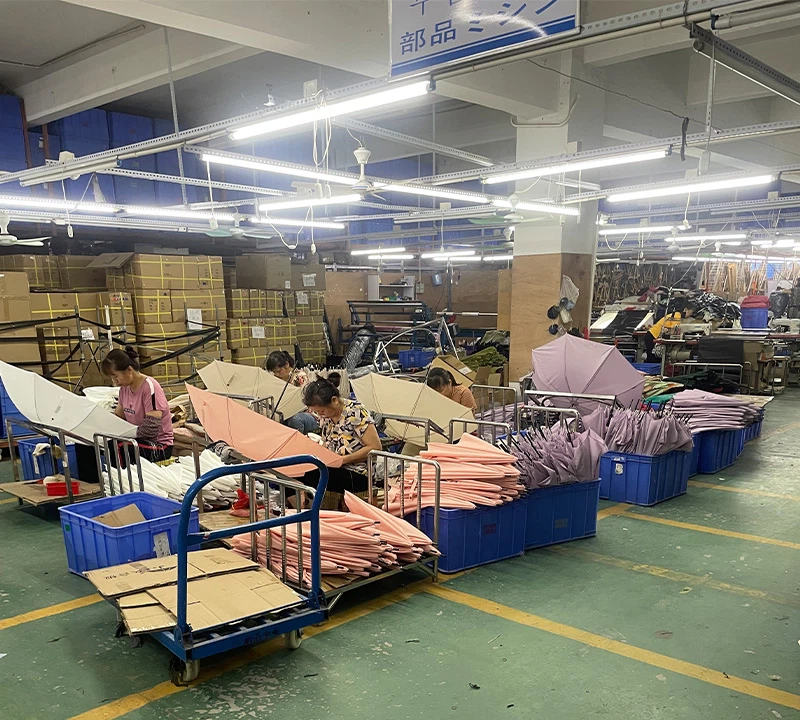
HeSanJiang focuses on umbrella manufacturing and provides OEM and ODM solutions for international customers. With more than 20 years of umbrella manufacturing experience and a 5,000+ square meter production workshop, the company can support different product requirements, from practical promotional umbrellas to premium carbon fiber models.


FAQ
Q: Why are carbon fiber umbrellas so expensive?
A: The higher price reflects the cost of carbon fiber materials, specialized processing, precision construction, testing, and premium components.
Q: Is carbon fiber more expensive than steel?
A: Generally, yes. Carbon fiber production and processing are more specialized, while steel benefits from mature mass-production methods.
Q: Does a higher price mean a better umbrella?
A: Not automatically. Frame design, joints, canopy quality, testing, and manufacturing consistency are equally important.
Q: Are carbon fiber umbrellas worth the higher price?
A: For frequent travelers, commuters, and premium-product buyers, the lightweight construction and advanced frame technology can justify the additional cost.
Q: Can brands customize carbon fiber umbrellas?
A: Yes. Depending on the manufacturer, brands can customize the canopy, frame, handle, printing, packaging, dimensions, and other specifications.
References
1 - National Renewable Energy Laboratory (NREL)
2 - U.S. Department of Energy